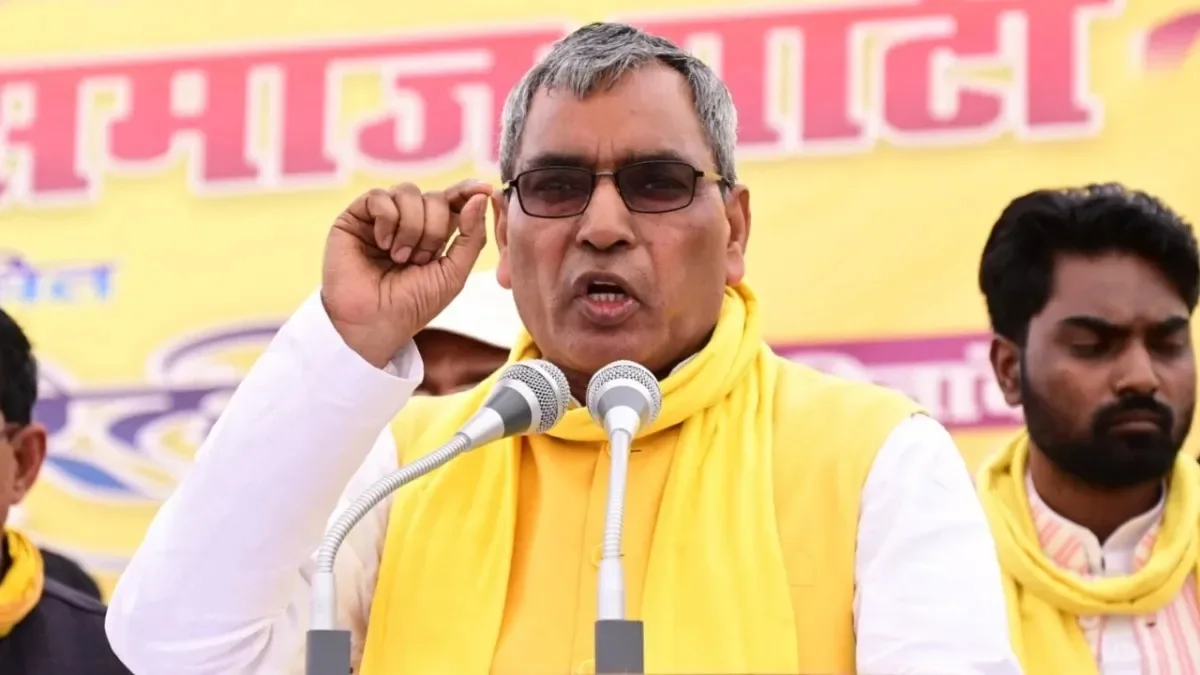
Lucknow: The long-running debate over the possible reorganisation of Uttar Pradesh has returned to the spotlight after state minister and Suheldev Bharatiya Samaj Party (SBSP) chief Om Prakash Rajbhar claimed that the state could be divided into four parts following a caste census. Rajbhar, whose party is an ally of the BJP in Uttar Pradesh, also claimed that Prime Minister Narendra Modi had assured him that the issue of dividing the state could be taken forward after caste-based population data became available. The remarks were made at an SBSP-organised Samajik Samrasta Maha Rally in Deoria on September 20. Rajbhar linked the proposed reorganisation with his demand concerning the distribution of the 27% OBC reservation.
What Did OP Rajbhar Claim?
During his address, Rajbhar said he had discussed the reservation issue with Prime Minister Modi. According to Rajbhar's account of that conversation, the caste census would provide the data needed to examine his demands and potentially move forward with the division of Uttar Pradesh. Rajbhar has therefore connected two separate but politically significant issuescaste enumeration and the reorganisation of Uttar Pradesh. He further claimed that the existing state would eventually be divided into four regions. In recent remarks, the regions have been described as Purvanchal, Madhyanchal, Bundelkhand and Harit Pradesh. However, Rajbhar's statement is a political claim. There has been no official announcement establishing a timetable or confirming a government decision to divide Uttar Pradesh into four states.
Rajbhar Also Talks About Purvanchal Leadership
Rajbhar went beyond the question of state reorganisation and spoke about the political leadership of a possible Purvanchal state. He said that if a separate Purvanchal state were created, representation of the Rajbhar community in its leadership would be an important condition for his political strategy. In another statement reported by the media, Rajbhar said that a future alliance involving his party would have to take into account his demand that the chief minister of a proposed Purvanchal state should come from the Rajbhar community. These comments have added a political dimension to the wider discussion about whether Uttar Pradesh should be reorganised into smaller administrative units.
Imran Masood Supports the Idea
Congress leader Imran Masood has also spoken in favour of dividing Uttar Pradesh into smaller states. Masood argued that the state's enormous geographical size creates administrative and travel challenges. He said that travelling between distant parts of Uttar Pradesh can take considerable time and suggested that smaller states could make administration easier. His remarks came after Rajbhar revived the issue and indicated that the proposal has support from political figures outside Rajbhar's party as well. Masood's support, however, should not be interpreted as evidence that a formal state-reorganisation process has begun.
Four-State Proposal Has Been Discussed Before
The idea of dividing Uttar Pradesh is not new. One of the most prominent proposals came from the government of former chief minister Mayawati. In 2011, the Uttar Pradesh Legislative Assembly passed a resolution proposing that the state be divided into four regions: Purvanchal, Bundelkhand, Awadh Pradesh and Paschim Pradesh. The proposal did not result in the creation of four new states. The demand has resurfaced at different points over the years, particularly around elections and debates over regional development. There have also been separate demands for states such as Purvanchal and Bundelkhand, with supporters arguing that smaller administrative units could address regional differences more effectively.
Uttar Pradesh Has Been Reorganised Before
Uttar Pradesh has already undergone a major territorial reorganisation. In 2000, the hill districts of the state were separated to create Uttarakhand, which was initially known as Uttaranchal. The creation of Uttarakhand remains the most recent major division of the former Uttar Pradesh. The present proposal being discussed is considerably broader, involving a possible four-way restructuring of the remaining Uttar Pradesh.
What Would Be Required to Create New States?
Dividing Uttar Pradesh would not happen simply through a political announcement or a state-level resolution. Under Article 3 of the Constitution, Parliament has the authority to create new states, alter state boundaries or change the area or name of an existing state. A bill for this purpose requires the President's recommendation before it can be introduced in Parliament. If the proposal affects the area, boundaries or name of a state, the President refers it to the concerned state legislature for its views. The state legislature's views, however, are not binding on Parliament. This means that any actual division of Uttar Pradesh would require a formal constitutional and parliamentary process.
Why Has the Issue Returned Now?
Rajbhar's comments come as Uttar Pradesh approaches its 2027 Assembly election, giving the debate an important political context. The discussion also comes alongside renewed attention to caste enumeration and OBC representation. Rajbhar has repeatedly raised the issue of distributing the existing OBC reservation among different communities. His latest comments have therefore brought together several issues: regional development, state reorganisation, caste data, reservation and political representation.
What Happens Next?
For now, the four-state division remains a proposal and political claim rather than an approved government plan. Rajbhar has said that the division could follow the caste census, while Imran Masood has expressed support for the broader idea of smaller states. At the same time, any actual reorganisation would require the constitutional procedure under Article 3 and action by Parliament. The renewed discussion is likely to keep the question of Uttar Pradesh's size, regional administration and political representation in the public debate as the state moves towards its next Assembly election.