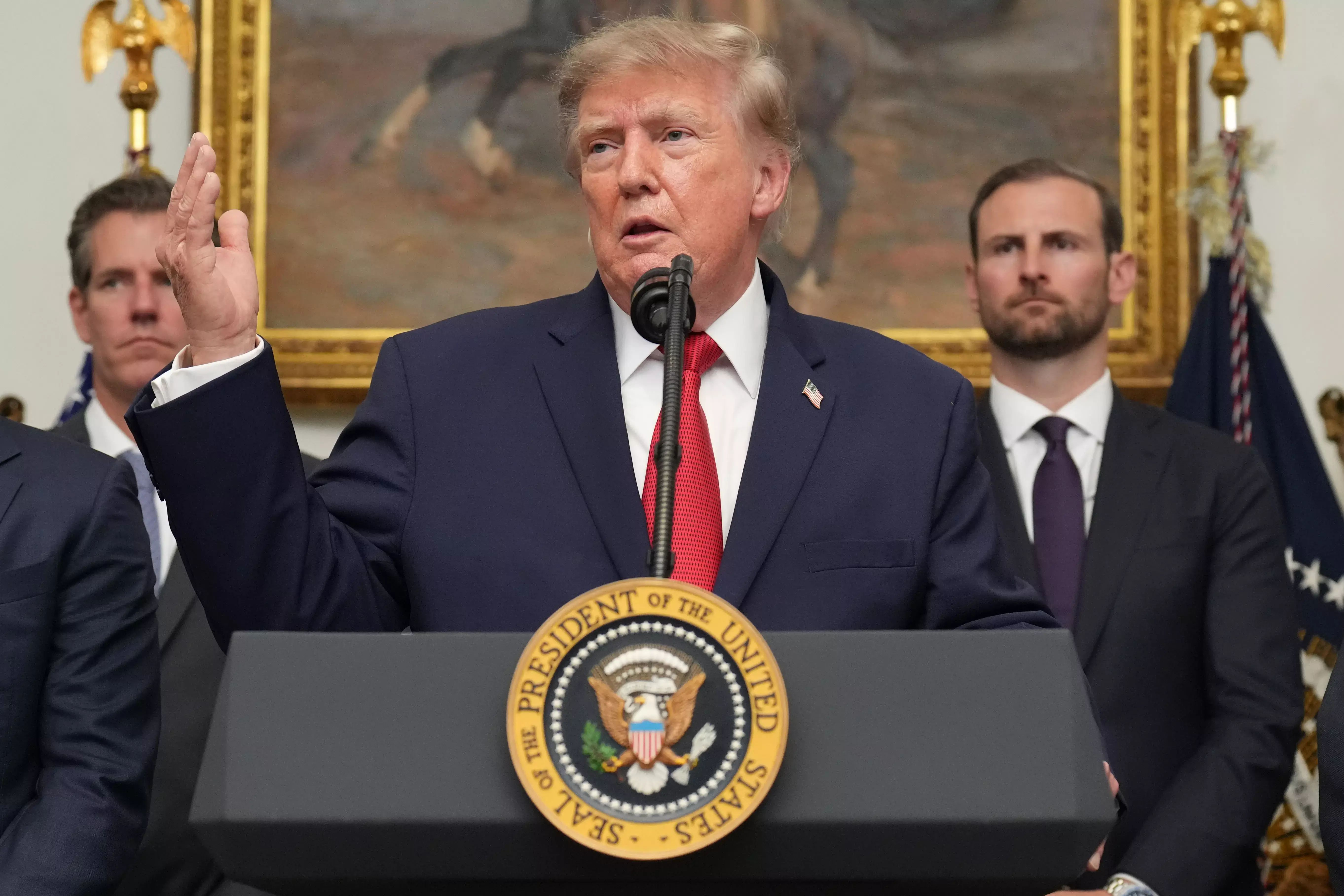
New Delhi: President Donald Trump of the United States has declared a significant intensification of Washington's economic campaign against Iran, threatening nations and companies that continue to give Tehran financial or commercial support with dire economic repercussions. Trump claimed that Iran had failed to come to a more comprehensive agreement with the US and characterized the action as an unparalleled campaign of economic warfare and isolation. His latest warning has increased uncertainty for countries that maintain trade, financial or energy-related links with Iran. The decision is made as the US-Iran dispute moves closer to yet another crucial stage, with diplomatic efforts encountering significant challenges and tensions over the strategically significant Strait of Hormuz still having an impact on international markets.
Trump Calls It an Economic D-Day
In his most recent statement, Trump urged US allies to join efforts to isolate Tehran and declared that Washington would step up pressure on Iran's economy. The US president issued a warning, stating that "tremendous" economic repercussions might befall nations whose financial institutions, businesses, airports, or government agencies supply what Washington views as a lifeline to Iran. The warning is particularly significant because Washington has not clearly identified which countries could become targets. Instead, Trump indicated that those governments already understand the message being delivered by the United States. Financial transactions, oil-related operations, shipping networks, currency exchanges, and businesses accused of assisting Iran in evading sanctions are anticipated to be among the administration's priorities.
Why Irans Trading Partners Are Watching Closely
Iran has maintained commercial relationships with several major economies despite years of US sanctions. While nations like India, Turkey, Japan, South Korea, and Germany have also had varied degrees of economic interaction with Tehran, China has been especially significant to Iran's oil trade. That makes the latest announcement more complicated than a conventional sanctions package. The consequences could go beyond Tehran and lead to fresh hostilities with important trading partners if Washington tries to punish international businesses or financial institutions for engaging in lawful business with Iran. The possibility of secondary sanctions is therefore attracting significant attention. International companies may find themselves in a challenging situation if they are forced to decide between continuing to do business with sanctioned Iranian enterprises and retaining access to the US financial system.
Oil and Shipping Could Become Major Pressure Points
One of the biggest concerns is Irans energy sector. Iran remains a significant oil producer, and restricting its ability to sell crude internationally could put additional pressure on government revenues. Washington has already spent months targeting Iranian sources of income through sanctions and other economic measures. The latest threat could go further by targeting the networks that allegedly help Iranian oil reach international buyers. Shipping is another critical area. The Strait of Hormuz, through which a substantial share of the worlds oil and liquefied natural gas traditionally moves, has become one of the most closely watched locations in the conflict. Reduced shipping through the waterway has already contributed to concerns about energy supplies, freight costs and inflation. Recent market reports showed crude oil trading above $92 a barrel amid renewed fears over regional supply disruptions.
UAE Decision Adds to Irans Economic Isolation
The pressure on Tehran has also increased after the United Arab Emirates announced the suspension of trade and financial dealings with Iran following renewed missile-related tensions. The UAE has historically been an important commercial and re-export hub for Iranian trade, making the decision particularly significant for Tehrans access to international markets. The move could make it harder for Iranian businesses to access foreign currency, shipping services and international commercial networks at a time when the country is already facing extensive economic pressure.
No Clear Diplomatic Breakthrough
Trumps economic warning also comes against the backdrop of stalled negotiations. A 60-day framework agreed in June was intended to create space for negotiations over the conflict, Irans nuclear programme and US sanctions. However, the deadline passed without a comprehensive settlement, leaving the diplomatic process in a highly uncertain position. Trump has recently said that there are no scheduled talks with Iran, while other statements from officials have suggested that diplomatic contacts may not have completely disappeared. That mixed messaging has added another layer of uncertainty to the situation.
What Could Happen Next?
The biggest question is how Washington will implement its latest threat. If the United States targets only Iranian entities and existing sanction-evasion networks, the consequences may remain largely focused on Tehran. However, if Washington begins aggressively targeting companies and financial institutions in countries that continue trading with Iran, the situation could quickly become a wider international economic dispute. China could be particularly important because of its economic relationship with Iran. Any major confrontation over Iranian oil purchases could add another source of tension to already complicated US-China relations. For India and other countries with longstanding commercial relationships in the region, the situation will also require careful balancing between energy security, international trade interests and compliance with US restrictions. For global markets, meanwhile, the Strait of Hormuz remains the key concern. Any further disruption to oil shipments could push energy prices higher and increase pressure on inflation-sensitive economies. Trumps Economic D-Day announcement therefore represents more than another sanctions warning. It signals a possible new stage in Washingtons strategy toward Tehranone in which the United States could increasingly target not only Iran itself, but also the international networks that help its economy function. As the conflict continues, the response of Irans major trading partners may determine whether Trumps strategy succeeds in creating deeper isolation or instead triggers a broader confrontation over global trade, energy and financial access.