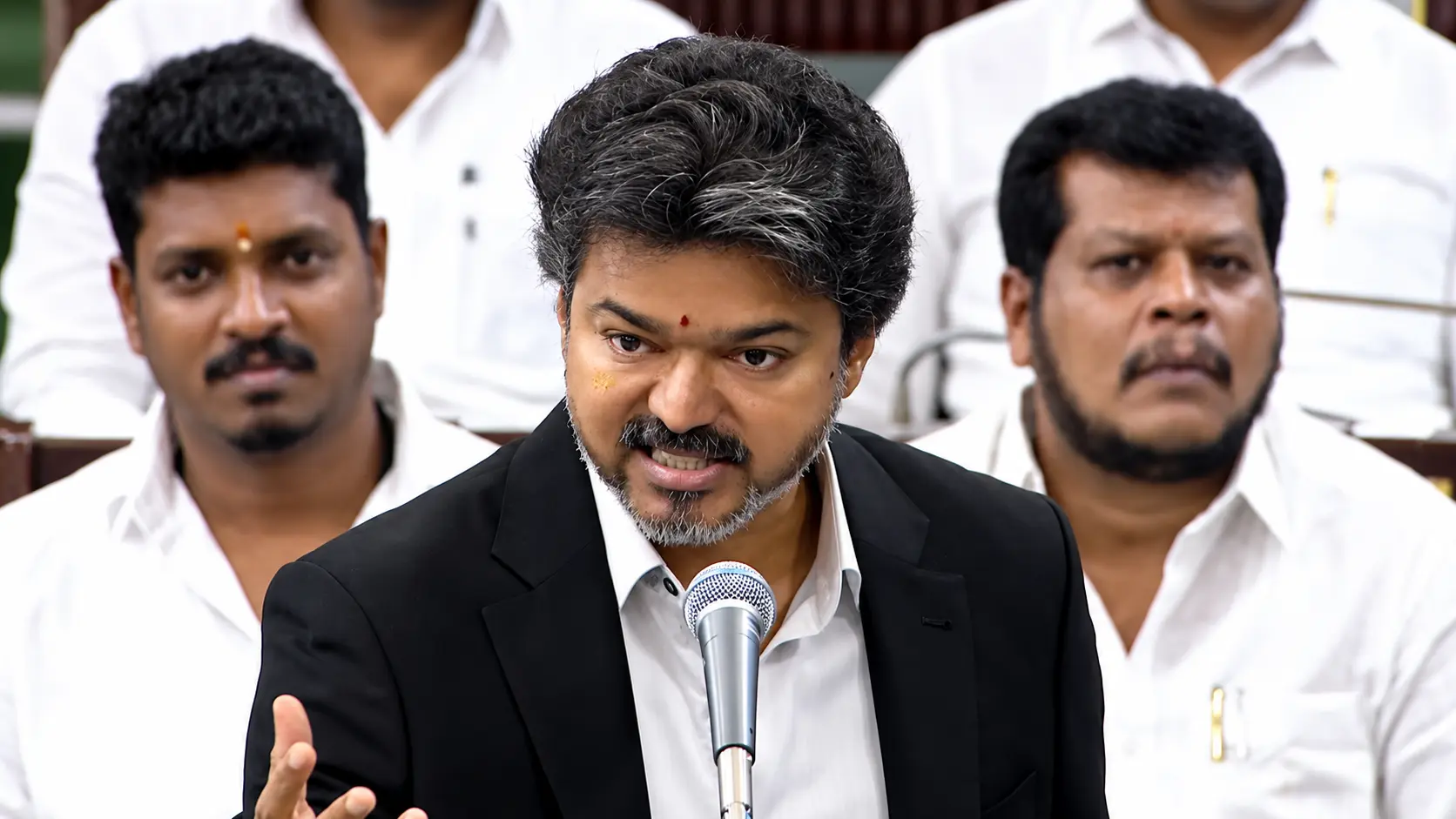
Chennai: The political temperature inside the Tamil Nadu Assembly rose sharply on Monday, September 7, after Chief Minister C. Joseph Vijay turned his reply to the police department debate into a wide-ranging political attack on the opposition Dravida Munnetra Kazhagam (DMK). What began as a response to questions over law and order quickly developed into one of the most dramatic confrontations of the Assembly session. Vijay accused the DMK of having a long history of corruption and nepotism and invoked several politically sensitive episodes, including the Sarkaria Commission report and the controversy surrounding the Veeranam drinking water project. His remarks triggered an immediate reaction from DMK legislators, who protested inside the House and demanded an opportunity for their leader, Udhayanidhi Stalin, to respond.
Vijay turns Assembly reply into political offensive
Vijay's speech was closely watched because he had already warned the DMK during the previous week's proceedings that he would give his reply and asked opposition members not to run away.When the Chief Minister began speaking on Monday morning, the DMK initially remained relatively quiet. The atmosphere changed as Vijay moved beyond the immediate police department debate and began discussing the DMK's political history and allegations of corruption. According to reports, Vijay referred to documents and past inquiries while questioning the DMK's record in government. He also criticised what he described as the party's political legacy of nepotism. The Chief Minister brought up the Sarkaria Commission, which was constituted in the 1970s to examine allegations concerning the then DMK government. He connected the commission's findings to the Veeranam drinking water project and alleged misuse of official authority. These references became a major flashpoint during his speech.
Veeranam issue becomes a major talking point
The Veeranam project has long remained part of Tamil Nadu's political history. Vijay used the episode to challenge the DMK's claims about its governance record. Rather than limiting his remarks to the performance of the current government, the Chief Minister sought to place the present political battle in the context of controversies involving previous DMK administrations. His strategy was clear: he wanted the Assembly debate on law and order to also become a discussion about the opposition party's past record. Vijay also referred to former Chief Ministers C.N. Annadurai and M.G. Ramachandran and used references to Tamil cinema and popular political culture to strengthen his message. His delivery included a raised voice, gestures and political punchlines, creating a highly charged atmosphere inside the House.
Party funds allegations add fuel to the confrontation
The most contentious portion of Vijay's speech involved his reference to material attributed to the Enforcement Directorate. The Chief Minister alleged that an ED document contained references to money allegedly collected as party funds in connection with government tenders. He referred to alleged percentages ranging from 7.5% to 10% and linked the claims to departments including Municipal Administration and Water Supply. Vijay also referred to what he called the Karur gang, presenting it as part of an alleged organised system of financial collection. Importantly, these were allegations presented by the Chief Minister while referring to investigative material; they should not be treated as judicially established findings unless proven through the appropriate legal process. Reporting on the speech similarly noted that the claims were not independently established during the Assembly proceedings. The allegations nevertheless dramatically escalated the political confrontation because they directly touched senior DMK figures and the party's financial functioning.
DMK MLAs storm the Well
As Vijay continued, DMK legislators began raising objections. Members reportedly displayed pamphlets and slogans before moving towards the Well of the House. The situation became increasingly disorderly as opposition MLAs surrounded the Speaker and demanded the right to answer the Chief Minister's accusations.DMK leaders argued that if the Chief Minister was allowed to make serious allegations against their party and leaders, the opposition should also be permitted to respond. Speaker J.C.D. Prabhakar, however, refused to immediately allow the DMK leadership to respond. He argued that the opposition members had prevented Vijay from speaking earlier and therefore could not demand an immediate opportunity after disrupting his address. The Speaker's position further intensified the confrontation, eventually leading to a protest and walkout by DMK members.
Udhayanidhi Stalin seeks opportunity to respond
DMK Deputy Leader K.N. Nehru was also seen approaching Vijay during the commotion and asking him to facilitate an opportunity for Udhayanidhi Stalin to respond. Vijay reportedly indicated that the decision rested with the Speaker. The episode highlighted the growing divide between the ruling establishment and the opposition at a time when Tamil Nadu politics is already witnessing intense competition between Vijay's TVK and the established DMK. The confrontation was not simply about a single Assembly speech. It reflected a broader political battle over who gets to define Tamil Nadu's governance record and political narrative.
Vijay invokes MGR and MISA
Another striking feature of the speech was Vijay's use of references to former Chief Minister and AIADMK founder M.G. Ramachandran. He also invoked the history surrounding the Maintenance of Internal Security Act, or MISA, while challenging the DMK's repeated references to its history of political resistance during the Emergency. Vijay questioned the political narrative surrounding MISA and suggested that the historical record should be examined more closely. He further positioned himself within the political tradition associated with leaders such as Annadurai and MGR, a move that carries significance in Tamil Nadu's highly personality-driven political landscape.
Women, political language and the Trisha controversy
Vijay's speech also moved beyond corruption and governance. The Chief Minister strongly criticised abusive and defamatory remarks directed at women in political discourse. While discussing the issue, he referred indirectly to the recent controversy involving actor Trisha and remarks attributed to Udhayanidhi Stalin. Vijay said political disagreements could be fierce but personal attacks and derogatory language against women should not be tolerated. He credited women voters as an important factor behind his political success and warned that his government would take such matters seriously.
A rare moment of political courtesy
Amid the shouting and protests, one unexpected moment attracted attention. DMK MLA Durai Chandrasekar reportedly had difficulty getting up after sitting on the floor during the protest. Vijay extended his hand and helped him stand. The brief gesture stood in contrast to the otherwise hostile proceedings and quickly became a talking point outside the Assembly.
Tamil Nadu politics enters another heated phase
The Assembly confrontation has added another chapter to the increasingly intense political rivalry between Vijay's TVK and the DMK. For Vijay, the speech provided an opportunity to portray his government as willing to confront the opposition directly while defending its position on law and order. For the DMK, the episode raised questions about whether the opposition was being given sufficient space to answer serious allegations made on the floor of the House. The political battle is therefore unlikely to end with Monday's proceedings. The Tamil Nadu Assembly ruckus, the Sarkaria Commission reference, the Veeranam controversy, the alleged party funds issue, and the dispute over the Speaker's decision are now likely to remain central talking points in Tamil Nadu politics. With both sides seeking to control the political narrative, the Assembly has become an important stage in the wider Vijay-versus-DMK contest. The coming days could see the opposition intensify its response, while the ruling side is expected to continue highlighting allegations against previous administrations. For voters, the larger question will ultimately be whether the political confrontation translates into measurable action on law and order, corruption, development and governance. For now, however, one thing is clear: Tamil Nadu politics has entered another fiercely contested phase, and the Assembly floor has become one of its most visible battlegrounds.