
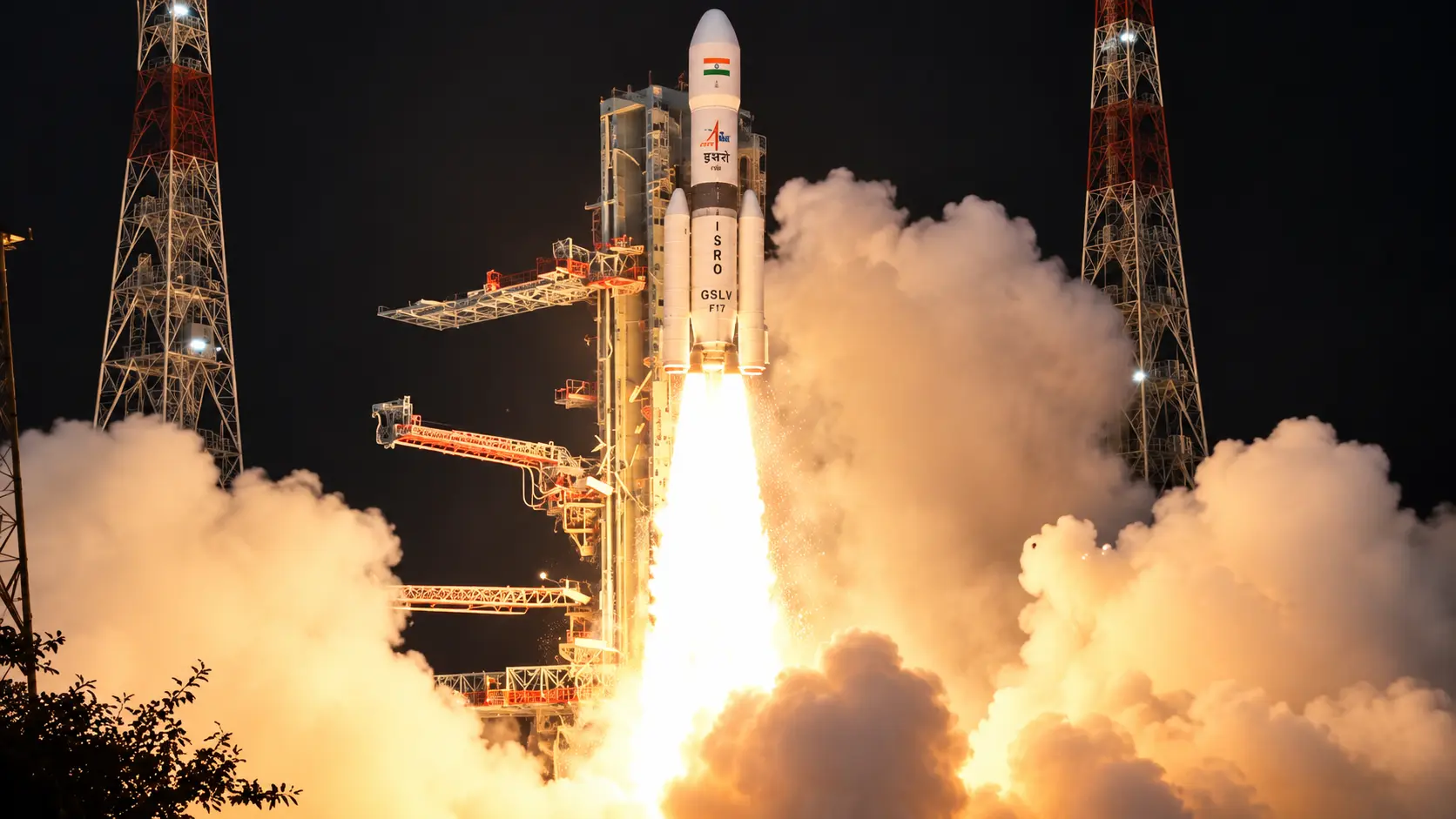
India has added another significant chapter to its expanding space programme with the successful launch of the GSLV-F17 rocket carrying the EOS-05 Earth observation satellite. The mission lifted off from the Satish Dhawan Space Centre in Sriharikota, Andhra Pradesh, during the early hours of Friday. The launch took place at 2:55 am IST, with the GSLV rocket rising into the pre-dawn sky and carrying the advanced satellite towards its designated orbit. Shortly after liftoff, the mission achieved its primary objective by placing EOS-05 into its planned sub-geosynchronous transfer orbit. The successful mission represents another important achievement for the Indian Space Research Organisation (ISRO) as it continues to expand India's satellite-based observation and imaging capabilities.
EOS-05 Successfully Deployed
Following the launch, ISRO confirmed that the satellite had been injected into its intended orbit with the required precision. ISRO Chairman Dr V Narayanan described the achievement as an important success for the GSLV programme. The EOS-05 satellite has been developed to provide sophisticated Earth observation capabilities. Its positioning in a high-altitude orbit is expected to support the continuous monitoring and imaging of the Indian subcontinent. The satellite is designed to capture information across several imaging bands, offering capabilities extending beyond conventional Earth observation. According to Science and Technology Minister Jitendra Singh, EOS-05 incorporates visible, infrared, multispectral and hyperspectral imaging technologies. Such capabilities can provide valuable information for applications involving agriculture, environmental monitoring, disaster management, infrastructure planning and other areas where detailed observations of the Earth's surface are required.
GSLV Adds Another Successful Mission
The GSLV-F17 stands approximately 51.7 metres tall and has a liftoff mass of around 420.5 tonnes, highlighting the scale of India's heavy-lift launch capabilities. Mission officials also emphasised the significance of the payload carried during this flight. The EOS-05 mission demonstrates the growing ability of India's launch vehicles to transport increasingly sophisticated and heavier satellites into high-altitude orbits. The achievement comes as ISRO continues to develop and operate increasingly capable launch systems for both domestic and international space requirements. The success of the mission is also significant for the broader development of India's independent access to space. Over the years, GSLV has evolved into one of the country's important launch platforms for heavier spacecraft and high-altitude missions.
Why EOS-05 Matters for India
Earth observation satellites play an important role in understanding changes taking place across the planet. By providing detailed and repeated images, such satellites can support government agencies, scientists and planners in making informed decisions.EOS-05's advanced imaging systems are expected to strengthen India's ability to monitor land, natural resources and environmental conditions. The satellite's near-real-time imaging capability could prove particularly useful during situations that require rapid information from affected areas. Satellite data can assist authorities in assessing floods, landslides, cyclones, fires and other natural or man-made events. Beyond disaster response, Earth observation technology has applications in crop monitoring, urban development, water-resource management and infrastructure planning.
Indias Space Programme Continues to Expand
The latest ISRO news comes at a time when India is pursuing several ambitious space projects. The successful EOS-05 mission is one part of a much broader programme aimed at strengthening the country's capabilities in satellite technology, launch vehicles, human spaceflight and navigation.ISRO is also moving ahead with preparations for the Gaganyaan mission, India's ambitious human spaceflight programme. Dr Narayanan said that work on the first uncrewed Gaganyaan flight is progressing with considerable intensity and that the mission is being targeted for launch during the current calendar year. The uncrewed mission is an important step before India attempts to send astronauts into space as part of the larger Gaganyaan programme. It will allow ISRO to evaluate critical systems and technologies under actual flight conditions before crewed missions.
More ISRO Missions Expected
The space agency's launch schedule is also expected to remain busy. According to ISRO leadership, several additional missions are targeted during the current financial year. Among them is NVS-03, part of India's navigation satellite programme. Navigation satellites are important for strengthening India's independent positioning, navigation and timing infrastructure. With multiple satellite launches and major programmes progressing simultaneously, ISRO is entering an increasingly active phase of India's space journey.
Indias Growing Position in Global Space
The successful GSLV-F17 launch further demonstrates India's growing expertise in developing and launching advanced spacecraft. From Earth observation and navigation to human spaceflight, India's space programme is increasingly focused on building capabilities with practical applications while also pursuing ambitious scientific goals. The EOS-05 mission therefore goes beyond a successful rocket launch. It adds another sophisticated observation platform to India's space infrastructure and demonstrates the increasing capabilities of the country's launch vehicles. As preparations for Gaganyaan accelerate and more satellite missions are planned, ISRO is expected to remain at the centre of India's rapidly developing space sector. The successful deployment of EOS-05 marks another step towards a future in which satellite technology plays an even greater role in India's security, development, disaster management and scientific research.