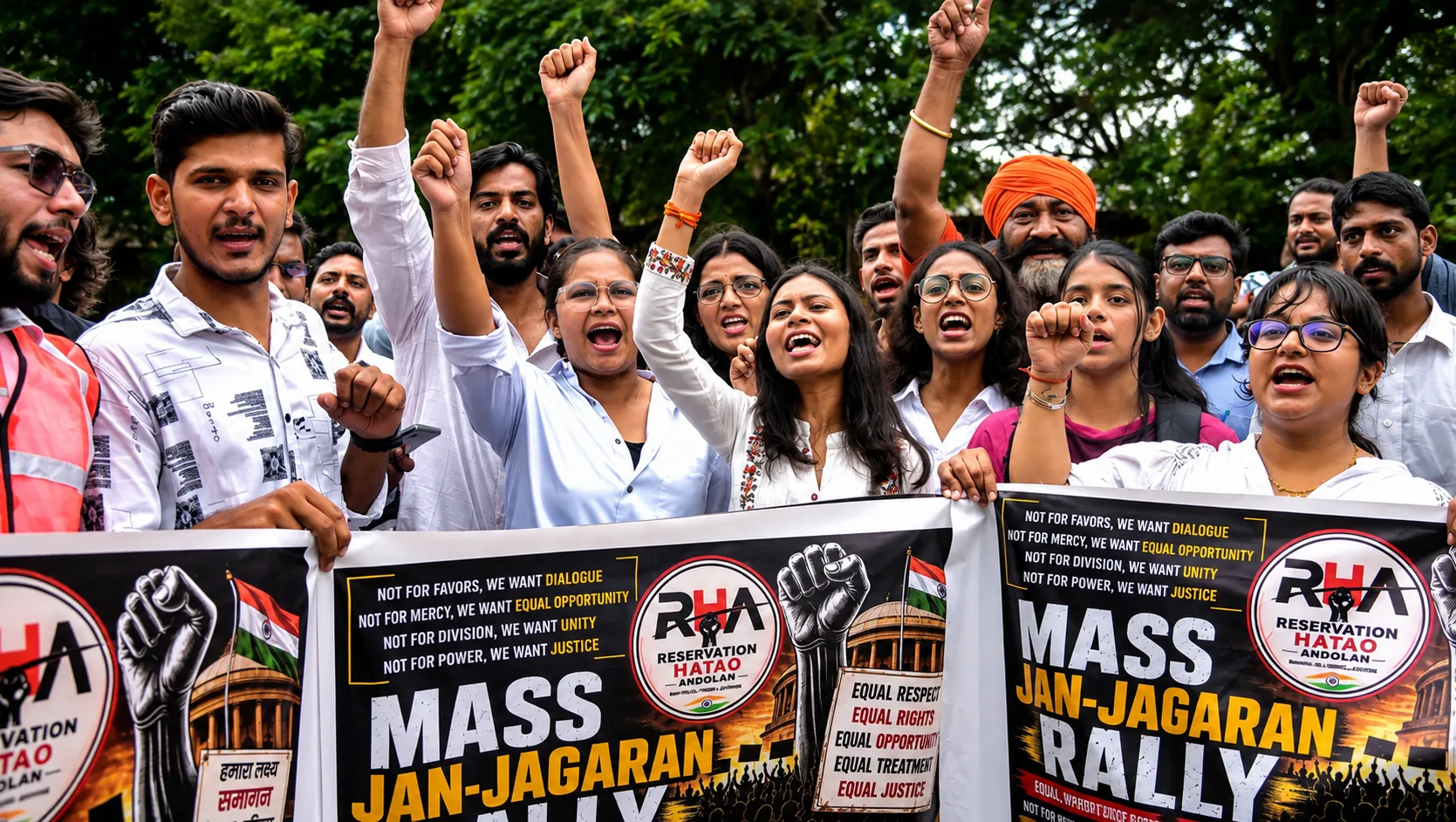
The Central Government has informed the Supreme Court that the 'creamy layer' principle cannot be extended to the Scheduled Castes (SC) and Scheduled Tribes (ST) reservation system. The Center defended the current policy by claiming that the creamy layer idea has only ever applied to OBCs and not to SC or ST communities. In opposition to a petition seeking an income-based sub-classification inside the SC and ST reservation categories, the government made their argument. The Center claims that reservations for certain groups stem from social isolation, historical discrimination, and constitutional protections rather than just financial standing.
Reservation Is Based on Social Justice, Not Just Income
India's reservation policy is not entirely based on economic factors, according to the Center's affidavit submitted to the Supreme Court. Instead, it is intended to address centuries of social discrimination, caste-based exclusion, and unequal access to opportunities experienced by Scheduled Castes and Scheduled Tribes. The government contended that although some families' economic circumstances might improve, the social and historical disadvantages connected to caste and tribal identity do not go away on their own. Therefore, it would be inconsistent with the constitutional goal of social fairness to base reservation benefits solely on income.
Centre Rejects Demand for Income-Based Sub-Quota
In order to provide priority to those who are less fortunate financially, the Supreme Court was asked to establish an income-based subcategory inside SC and ST reservations. The Center, however, disagreed with the plan, arguing that thorough empirical research, socioeconomic data, and in-depth policy analysis were necessary before any significant reorganization of the reservation system could be implemented. The government maintained that such a significant reform requires careful examination of its legal, constitutional, and social consequences. The Center claims that the fundamental goal of reservations could be compromised if income-based preferences are introduced without enough proof.
Only Parliament Can Decide on Such a Policy Change
The government further informed the Supreme Court that extending the creamy layer principle to SC and ST categories is a policy decision that falls within the jurisdiction of Parliament, not the judiciary. It urged the court to avoid issuing directions that would effectively redesign India's reservation framework, arguing that such decisions involve legislative policy and require broad democratic consultation. The Centre emphasized that any future change in the reservation structure should come through Parliament after extensive debate and evidence-based assessment.
What Is the Creamy Layer Concept?
The creamy layer principle applies to the Other Backward Classes (OBCs) and is intended to ensure that reservation benefits reach those who remain socially and educationally disadvantaged. Under this system, individuals from economically and socially advanced OBC families are excluded from reservation benefits once they meet the prescribed eligibility criteria, including the government's notified income threshold and other conditions. The objective is to prevent relatively privileged families within the OBC category from repeatedly receiving reservation benefits while ensuring that genuinely disadvantaged groups continue to receive support.
History of the Creamy Layer Principle
The idea of the creamy layer was first proposed by the Sattanathan Commission in 1971, which recommended excluding the more advanced sections of backward classes from reservation benefits. The concept later gained legal recognition through the Indra Sawhney (Mandal Commission) judgment of 1992, in which the Supreme Court upheld reservations for OBCs while directing that the creamy layer should be excluded. Since then, the principle has remained applicable only to OBC reservations and has never been formally extended to Scheduled Castes or Scheduled Tribes.
Why Has It Not Been Applied to SC and ST Communities?
The Centre argued that SC and ST reservations differ fundamentally from OBC reservations because they are based on the historical realities of caste discrimination, untouchability, and social exclusion rather than economic backwardness alone. According to the government, an increase in family income does not necessarily eliminate the social stigma or structural disadvantages historically faced by members of these communities. Therefore, applying the creamy layer principle to SC and ST categories requires a far more detailed constitutional and policy examination.
What Happens Next?
The Supreme Court will now consider the arguments presented by both the petitioners and the Central Government before deciding the future course of the case. For the time being, the Centre has made its position clear: the creamy layer principle should remain limited to OBC reservations, and any proposal to extend it to SC and ST categories can only be considered after a comprehensive review backed by data and through the legislative process. The case is expected to have significant implications for India's reservation policy and could shape future debates on affirmative action, social justice, and constitutional equality.