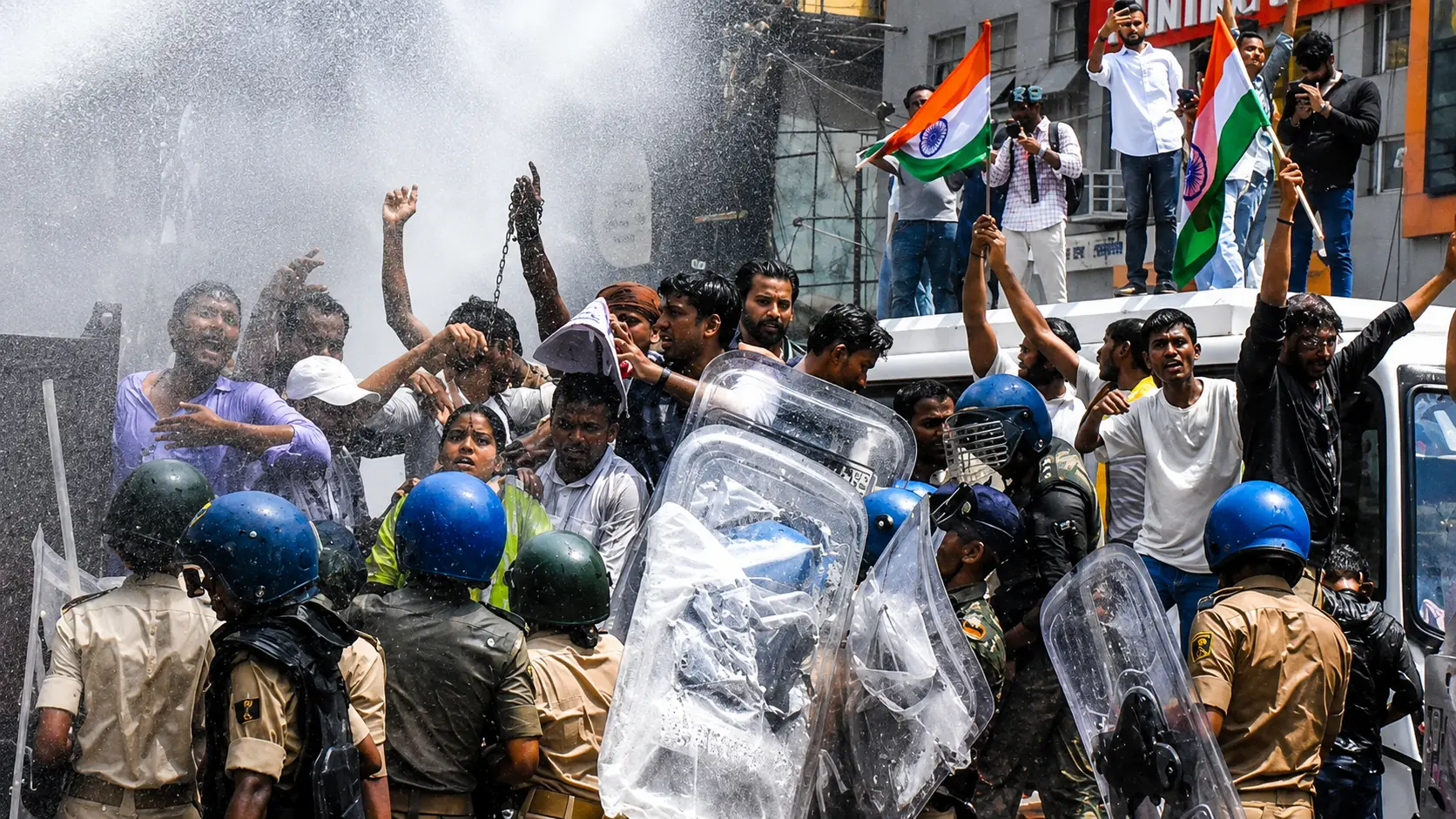
Patna witnessed heightened tension on Tuesday as students protesting against the 70th Bihar Public Service Commission (BPSC) examination attempted to march towards Raj Bhavan, leading to a confrontation with police. The protesters had gathered at Gandhi Maidan and moved towards the Raj Bhavan area while demanding cancellation of the 70th BPSC examination. The students alleged irregularities in the recruitment process and raised broader concerns about competitive examinations and government recruitment in Bihar.
As the march progressed, police placed barricades along the route to prevent the protesters from entering restricted areas. Several students attempted to cross the barricades, after which police detained a number of demonstrators. The protest has once again brought Bihar's competitive examination system into the spotlight, with students demanding greater transparency, faster recruitment and stronger action against alleged examination irregularities.
Why are Bihar students protesting?
The immediate focus of the protest is the 70th BPSC examination. Student groups have been demanding that the examination be cancelled, citing allegations of irregularities and concerns surrounding the integrity of the recruitment process. However, the protest has expanded beyond a single examination. Candidates are also raising concerns over the proposed Teacher Recruitment Examination, or TRE 4.0. Among their major demands is that the teacher recruitment examination should be conducted in a single stage rather than being divided into multiple phases. Students are additionally seeking the removal of negative marking and the publication of a clear recruitment notification. For many candidates, the issue is not simply about one examination. They argue that uncertainty surrounding recruitment schedules, delayed examinations and alleged irregularities have created prolonged stress for young people preparing for government jobs.
Police stop march towards Raj Bhavan
The situation became tense when demonstrators attempted to move beyond the police barricades. Officers repeatedly asked the students not to proceed towards the restricted area. Police officials said they were trying to maintain order while discussions with senior authorities were underway.DSP Kamakhya Narayan Singh said talks with senior officials had been encouraging and expressed hope that the protesters would reconsider their decision to continue the march. Despite those appeals, some students attempted to cross the barricades. Police subsequently detained several protesters as the situation escalated. The confrontation highlights the growing frustration among candidates who have been demanding government intervention in recruitment-related issues.
TRE 4.0 becomes another major issue
Teacher recruitment has emerged as another important part of the students' campaign. Protesters want TRE 4.0 to follow a single-stage examination format. They are also opposing the proposed arrangement under which the examination would be conducted in two phases across Bihar. Students have argued that a unified examination would make the recruitment process simpler and reduce confusion among candidates. They are also demanding that negative marking be removed. Another major demand is the release of the official recruitment notification so that candidates can understand the number of vacancies, eligibility requirements and examination schedule. The uncertainty has become particularly frustrating for candidates who have already spent considerable time preparing for government recruitment examinations.
Students raise wider recruitment concerns
The Patna demonstration has also brought attention to recruitment examinations conducted by other state agencies. Students have raised issues concerning the Bihar Staff Selection Commission, Sub-Inspector recruitment and other government examinations. Some protesters have alleged that recruitment examinations are frequently delayed and that candidates are not provided with a predictable examination calendar. Vikas Bhatt, one of the protesters, highlighted concerns over what he described as repeated delays and examination-related irregularities. He also pointed to vacancies and recruitment processes that, according to protesters, have remained unresolved for years. For students preparing for competitive examinations, delays can have serious consequences. Candidates may spend years preparing for jobs without knowing when the next examination will actually take place. This has strengthened demands for a transparent and fixed recruitment calendar.
Opposition demands talks with students
The student movement has also received political attention. Bihar Leader of Opposition Tejashwi Yadav has urged the state government to engage directly with protesting candidates and address their concerns. Yadav has supported the demand for a single-stage TRE-4 examination and raised concerns about the treatment of Hindi-speaking candidates during BPSC's mains examination and interview process. The opposition has also called for greater transparency in recruitment examinations. It has demanded an independent investigation into allegations of irregularities in previous examinations and stronger action against individuals or networks involved in manipulating recruitment processes. The political intervention has added another dimension to the ongoing protest, placing greater pressure on the Bihar government to respond to the students' demands.
Government launches student grievance camps
Amid the protests, the Bihar government announced a new initiative aimed at addressing student complaints. Chief Minister Samrat Choudhary announced the launch of monthly 'Vidyarthi Sahyog Shivir', or student support camps. According to the government, the camps will be organised at educational institutions on the fourth Tuesday of every month. The stated objective is to give students a direct channel through which they can submit grievances to government officials. The government has also said students will be able to submit complaints online and monitor the progress of their cases through a dedicated system. A helpline has also been announced to facilitate complaints and assistance. The move comes at a time when student dissatisfaction over recruitment examinations has become an increasingly visible issue in Bihar.
Why the recruitment issue matters
Government jobs remain highly sought after among young people in Bihar, where competitive examinations attract large numbers of candidates. For aspirants, even a small delay can affect preparation schedules, eligibility and future career plans. Allegations of paper leaks or other irregularities can further damage confidence in the recruitment system. Students therefore want examination authorities to provide clearer schedules, stronger security arrangements and transparent procedures. Their demands also reflect a broader concern: candidates want assurance that success in a competitive examination will depend on preparation and performance rather than administrative uncertainty.
What happens next?
The immediate challenge for the Bihar government is to prevent the situation from escalating while creating a credible channel for negotiations. The launch of student grievance camps could provide one avenue for addressing complaints, but protesters are seeking specific commitments on examinations and recruitment. The government will likely face pressure to clarify its position on the 70th BPSC examination, TRE 4.0, and pending recruitment processes. For students, the key issue is whether their demands will lead to concrete changes rather than another round of assurances. The Bihar BPSC protest 2026 has therefore become more than a demonstration over one examination. It has developed into a wider campaign focused on recruitment transparency, examination reliability and accountability. As talks between students and authorities continue, the coming days will be important in determining whether the dispute can be resolved through dialogue or whether further protests are likely in Patna and other parts of Bihar.