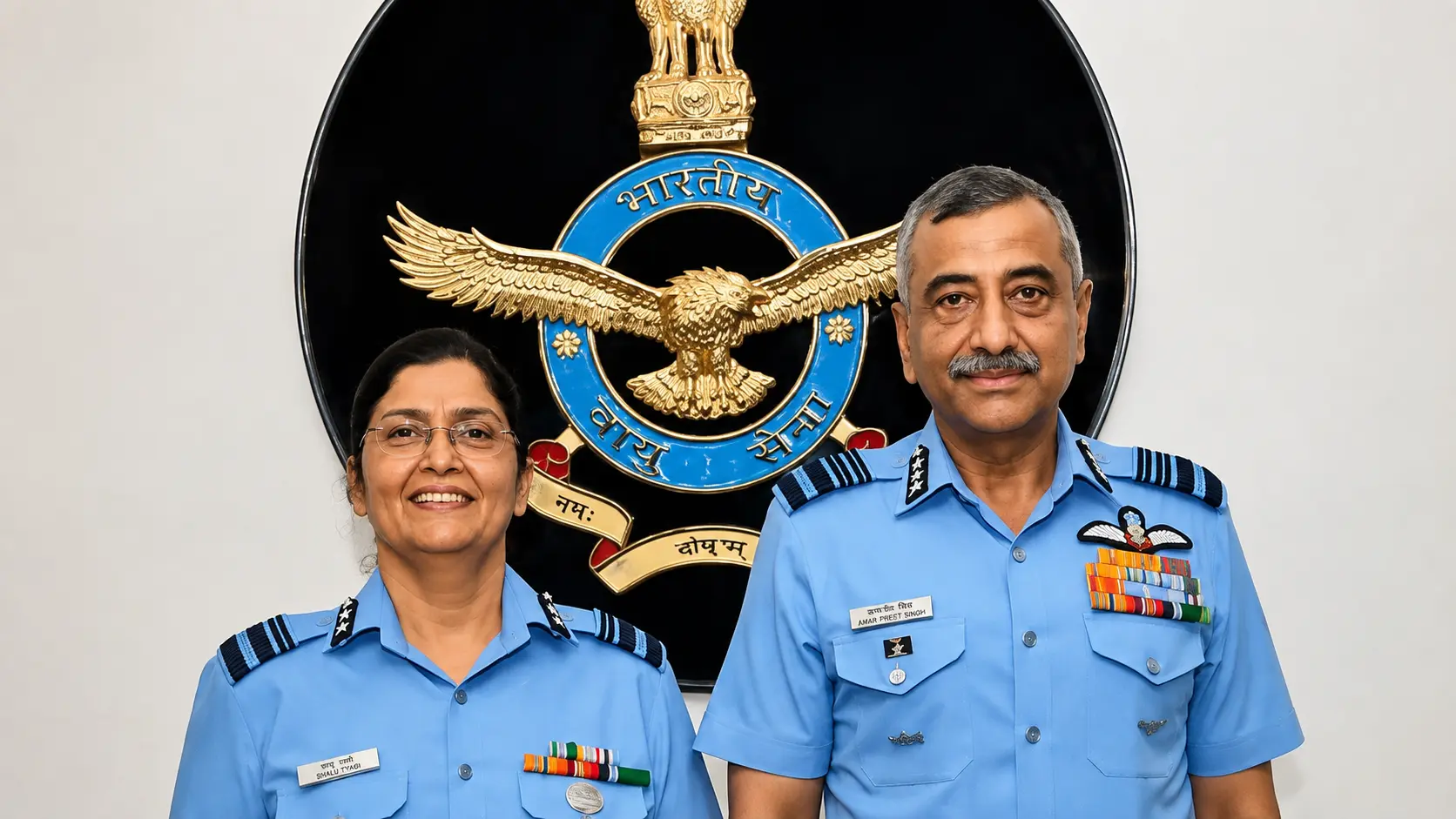
Air Vice Marshal Shakti Sharma has created history by becoming the first woman officer from the non-medical stream in the Indian Defence Services to achieve the rank of Air Vice Marshal or equivalent two-star rank.
A new chapter has opened in the history of women in India's armed forces with Air Vice Marshal Shakti Sharma becoming the first woman officer from the non-medical branch to attain the rank of Air Vice Marshal. Sharma assumed charge as Assistant Chief of the Air Staff (Education) at Air Headquarters on September 1, 2026. Her elevation is being seen as an important milestone in the increasing participation of women in senior leadership positions within the Indian military. Her achievement is particularly significant because her career has been rooted in the Indian Air Force's Education Branch rather than the medical services. Over more than three decades, she has handled responsibilities across training institutions, field stations, command headquarters and Air Headquarters.
Who is Air Vice Marshal Shakti Sharma?
Shakti Sharma joined the Indian Air Force Education Branch on June 18, 1994. Since receiving her commission, she has built a career spanning more than 30 years, taking on assignments connected with education, training, administration and institutional development. Her professional journey has included postings at different levels of the IAF. This experience has allowed her to work across training establishments, field formations, command headquarters and the Air Headquarters. Before her elevation to Air Vice Marshal, Sharma had already achieved several distinctions during her career. Her latest appointment as Assistant Chief of the Air Staff (Education) places her in a senior position at Air Headquarters, where her experience in military education and institutional development is particularly relevant.
Shakti Sharma's historic Sainik School role
One of the notable milestones in Sharma's career came before her promotion to the two-star rank. She became the first woman officer from the Tri-Services to command a Sainik School, serving as the Principal of Sainik School, Kapurthala. The role gave her an opportunity to lead an institution closely associated with India's military education system. Sainik Schools prepare students for disciplined careers and encourage young people to pursue opportunities in the armed forces. Her leadership at the school added another important dimension to a career that has consistently combined military service with education.
Contribution to academic and defence collaboration
Sharma's work has also extended beyond conventional military assignments. During her career, she played a key role in establishing IAF Chairs of Excellence at IIT Kanpur and Pune University. These initiatives were designed to strengthen connections between the Indian Air Force and academic institutions while encouraging collaboration in areas of strategic and defence relevance. The initiatives underline the growing importance of cooperation between India's armed forces and leading educational institutions. Such partnerships can provide opportunities for research, knowledge exchange and discussion around emerging defence challenges. For an officer from the Education Branch, Sharma's contribution to these institutional initiatives represents an important part of her professional legacy.
A three-decade journey in the IAF
Sharma's rise to Air Vice Marshal is the result of a career that began in 1994 and has continued through several stages of the Indian Air Force. Over the years, she has worked in different environments, from training establishments and field stations to command-level headquarters and Air Headquarters. Her career demonstrates how the role of women officers in India's armed forces has evolved over the past three decades. The Indian military has gradually expanded opportunities for women across different branches and responsibilities. Sharma's elevation is another indication of that changing landscape, particularly because her achievement comes from a non-medical stream.
Why Shakti Sharma's promotion is significant
The significance of Sharma's promotion goes beyond an individual career milestone. She is the first woman officer from the non-medical stream in the Indian Defence Services to reach the Air Vice Marshal rank or equivalent. In practical terms, this means she has broken a significant barrier in the progression of women officers toward India's higher military leadership. The development also comes at a time when women are increasingly taking on responsibilities across India's defence establishment. From aviation and education to operational assignments and command roles, women officers have increasingly become part of areas that were historically dominated by men. Sharma's career adds another important example to this broader transformation.
New responsibility as Assistant Chief of Air Staff
On September 1, Sharma officially assumed the appointment of Assistant Chief of the Air Staff (Education) at Air Headquarters. Her new position comes with the benefit of more than three decades of experience in military education and related institutional responsibilities. Her background in academic collaboration, training establishments and educational leadership makes the appointment particularly relevant to her professional journey. The Ministry of Defence described her elevation as a landmark moment in the journey of women officers in India's Defence Services. It also highlighted her distinguished service of more than three decades.
A milestone for women in India's armed forces
Shakti Sharma's story is significant because it represents a gradual change in the structure of India's military leadership. Her journey from being commissioned into the Education Branch in 1994 to becoming an Air Vice Marshal more than three decades later demonstrates the possibilities available to women officers who progress through different levels of military service. Her achievements at Sainik School Kapurthala and her contribution to IAF-academic partnerships further distinguish her career. As she takes charge of her new responsibility at Air Headquarters, her promotion is likely to remain an important reference point in discussions about women in the Indian Armed Forces. For aspiring women officers, Sharma's career represents more than a historic rank. It reflects a long professional journey combining military service, education, leadership and institutional development. Her achievement therefore marks not just a personal accomplishment but another significant step in the continuing evolution of India's armed forces.