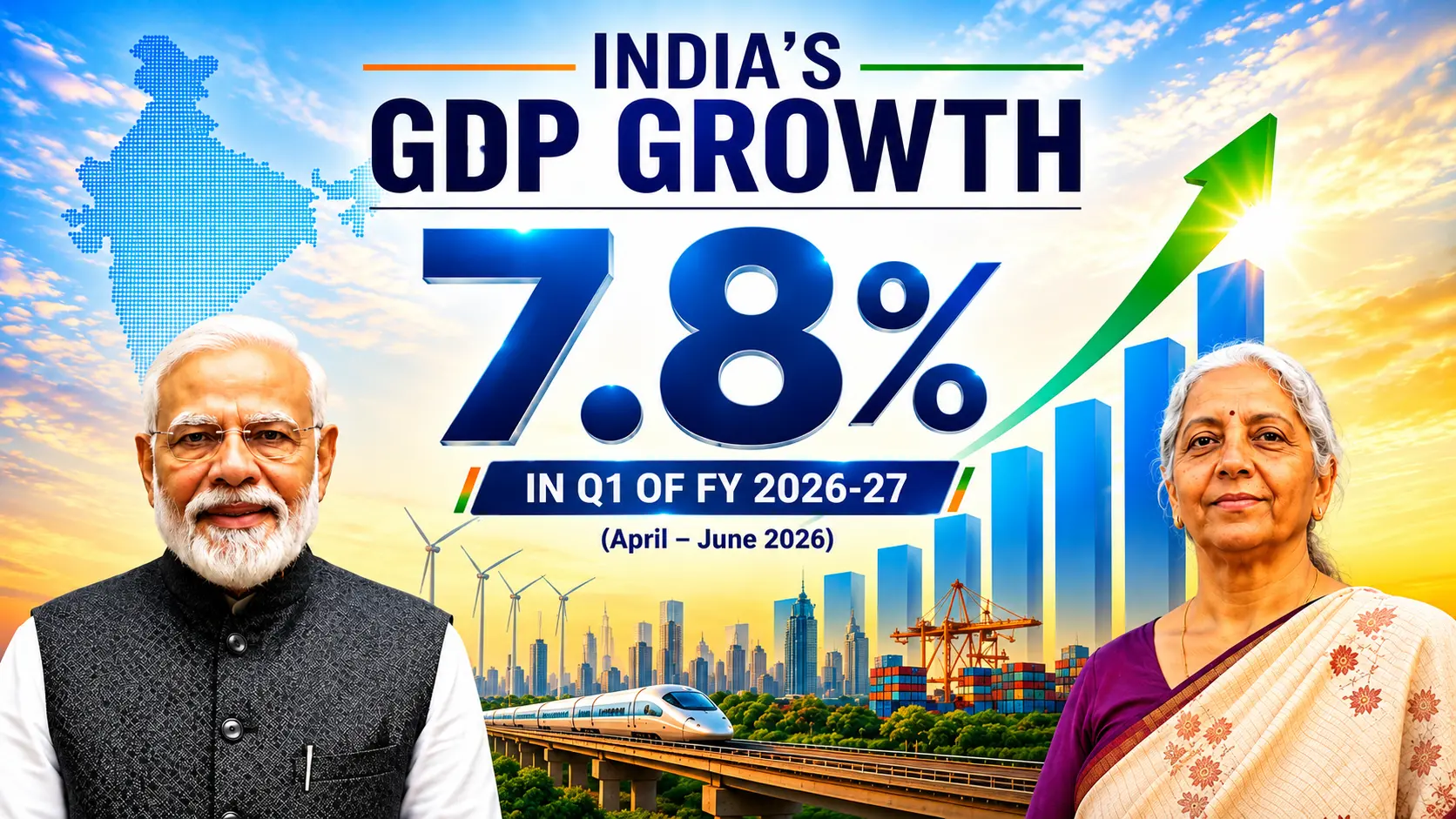
India's economy has delivered a stronger-than-expected performance, with GDP growth of 7.8% in the first quarter, surprising economists and offering a major boost to the government at a time when global economic conditions remain uncertain. The latest numbers indicate that Asia's third-largest economy has managed to maintain considerable momentum despite the disruption in energy markets caused by the Middle East conflict and the continuing uncertainty surrounding the Strait of Hormuz. Prime Minister Narendra Modi welcomed the figures, arguing that the latest growth data had once again proved wrong those who had predicted a slowdown in the Indian economy. However, the headline number has also triggered a heated debate. While government supporters and several economists see the growth figure as evidence of economic resilience, critics have questioned the methodology behind the revised GDP series and whether the headline rate accurately reflects conditions on the ground.
India GDP Growth Beats Expectations
The 7.8% quarterly growth figure came in significantly stronger than many market expectations. The performance suggests that economic activity remained resilient even as India faced higher geopolitical risks, uncertainty over energy supplies and pressure on its currency. India remains heavily dependent on imported crude oil, making the country particularly vulnerable to sudden increases in international energy prices. Any prolonged disruption around the Strait of Hormuz could potentially increase India's import bill, put pressure on inflation and affect businesses and consumers. Yet, the latest India GDP growth figures suggest that the economy has so far absorbed much of that pressure. Economists point to several factors behind the performance, including stronger exports, government support, improving private investment and relatively favourable financial conditions.
Government Measures Helped Support Economic Activity
Indias recent economic recovery did not happen in isolation. A combination of fiscal and monetary measures has helped support consumption and investment. Tax reductions, changes to consumption taxes and lower interest rates have provided additional support to households and businesses. These measures have helped maintain demand even while international conditions became more difficult. Economists have also highlighted the government's efforts to diversify energy supplies after the disruption in the Middle East. For an economy that imports a large proportion of its crude oil requirements, maintaining access to energy has been critical. Diversifying suppliers and adjusting purchasing strategies helped India reduce some of the immediate risks associated with the oil shock. That resilience has become an important part of the latest India economy news narrative.
Exports Provide Another Major Boost
One of the most notable elements of the latest economic data has been the improvement in exports. Indian exports increased sharply during the period despite uncertainty surrounding international trade and tariffs. A weaker rupee against the US dollar may have also helped Indian exporters become more competitive in global markets. A depreciating currency can increase the rupee value of export earnings and make domestically produced goods relatively cheaper for overseas buyers. However, currency weakness is not universally positive. A weaker rupee can simultaneously make imported crude oil, machinery and other raw materials more expensive. Therefore, whether the currency ultimately supports growth will depend on the balance between export gains and higher import costs.
Private Investment Finally Shows Signs of Recovery
For years, economists have closely watched India's private investment cycle. While public infrastructure spending has remained an important driver of economic activity, private companies have been slower to commit large amounts of capital. The latest figures provide some encouraging signals. Gross fixed capital formation, a measure that captures investment in areas such as infrastructure, machinery and buildings, recorded strong growth during the quarter. New investment announcements have reportedly been concentrated in sectors including data centres, renewable energy and metals. This could become particularly important for India's long-term growth prospects. If companies continue expanding factories, technology infrastructure and other productive assets, the country could create additional employment while increasing its overall productive capacity. However, economists caution that private investment is still not broad-based enough to declare a complete investment revival.
GDP Data Sparks Political Controversy
Despite the impressive headline figure, the latest GDP release has quickly become politically controversial. Opposition leaders have questioned whether changes to the methodology and revisions to historical data have made the current growth rate appear stronger. Critics argue that the introduction of a revised GDP series and changes to the calculation base have affected comparisons between the current period and previous years. The government has rejected allegations that GDP data has been manipulated. Officials and economists supporting the revised methodology argue that updating statistical methods is a normal part of economic measurement and can improve the quality of national accounts. The debate is therefore not simply about whether the economy is growing, but about how accurately the headline growth rate represents the underlying economy.
Why Strong GDP Growth Has Not Ended Economic Concerns
A high GDP growth rate does not automatically mean that every section of society is benefiting equally. Questions surrounding employment, wages, rural demand and foreign investment continue to remain important. Former Reserve Bank of India governor Raghuram Rajan has previously raised questions about the relationship between India's reported growth and the country's ability to generate sufficient jobs and attract investment. This remains one of the biggest challenges for policymakers. India needs sustained economic expansion that translates into employment opportunities, higher household incomes and stronger consumption. A rapidly growing economy that does not generate enough productive jobs could still face significant social and economic pressures.
Rural Economy Faces Monsoon Risk
Another major concern is the performance of agriculture. India's rural economy remains highly sensitive to rainfall because millions of households depend directly or indirectly on agriculture. A weaker monsoon can affect crop production, rural incomes and food prices. Rainfall levels have remained below the long-term average, raising concerns about agricultural output in some regions. The consequences could extend beyond farmers. Lower agricultural production can push up food prices, affecting household budgets across the country. Prices of important commodities such as onions and sugar have already experienced pressure, highlighting the risks associated with supply disruptions.
Inflation Could Become a Bigger Challenge
India's economic outlook is also being shaped by inflation. If food prices continue rising while energy costs remain elevated, policymakers could face a difficult balancing act. Supporting economic growth while keeping inflation under control becomes considerably harder when both demand and supply pressures are present. Higher global oil prices would create another challenge. India imports a substantial share of its crude oil, meaning geopolitical instability can quickly affect domestic fuel and transportation costs. Higher energy prices can eventually increase the cost of producing and transporting goods across the economy.If inflation becomes persistent, expectations of tighter monetary policy could increase.
Stock Market Reaction Remains Cautious
Interestingly, India's strong GDP numbers have not generated an equally dramatic reaction from the stock market. Investors appear to be weighing the positive economic data against several risks, including global trade uncertainty, geopolitical tensions, oil prices, inflation and the possibility of higher interest rates. Markets typically look beyond a single quarter's growth figure. Investors are more interested in whether the momentum can continue over several quarters. That is particularly relevant now because some temporary factors supporting growth may weaken. Government spending could moderate as authorities focus on fiscal targets, while the initial boost from tax changes may gradually fade.
Can India Maintain the Growth Momentum?
The central question now is whether India's economy can maintain growth close to the current pace. The answer will depend on several factors. Strong private investment, healthy exports, stable energy supplies and improving consumer demand could help sustain momentum. On the other hand, higher oil prices, weaker global demand, disappointing monsoon conditions and persistent inflation could create significant obstacles. The India GDP growth 2026 story is therefore more complicated than the 7.8% headline figure suggests. The latest data undeniably provides evidence that the Indian economy has considerable resilience. It has weathered external shocks better than many feared and continues to attract investment in several emerging industries. But policymakers cannot afford to treat one strong quarter as proof that all economic challenges have disappeared. India's next challenge will be converting headline growth into broader prosperitymore jobs, higher rural incomes, sustained private investment and controlled inflation. For now, the latest GDP numbers give the government a reason to celebrate. But whether this becomes the beginning of a prolonged growth cycle or simply the peak of a temporary acceleration will become clearer in the quarters ahead.