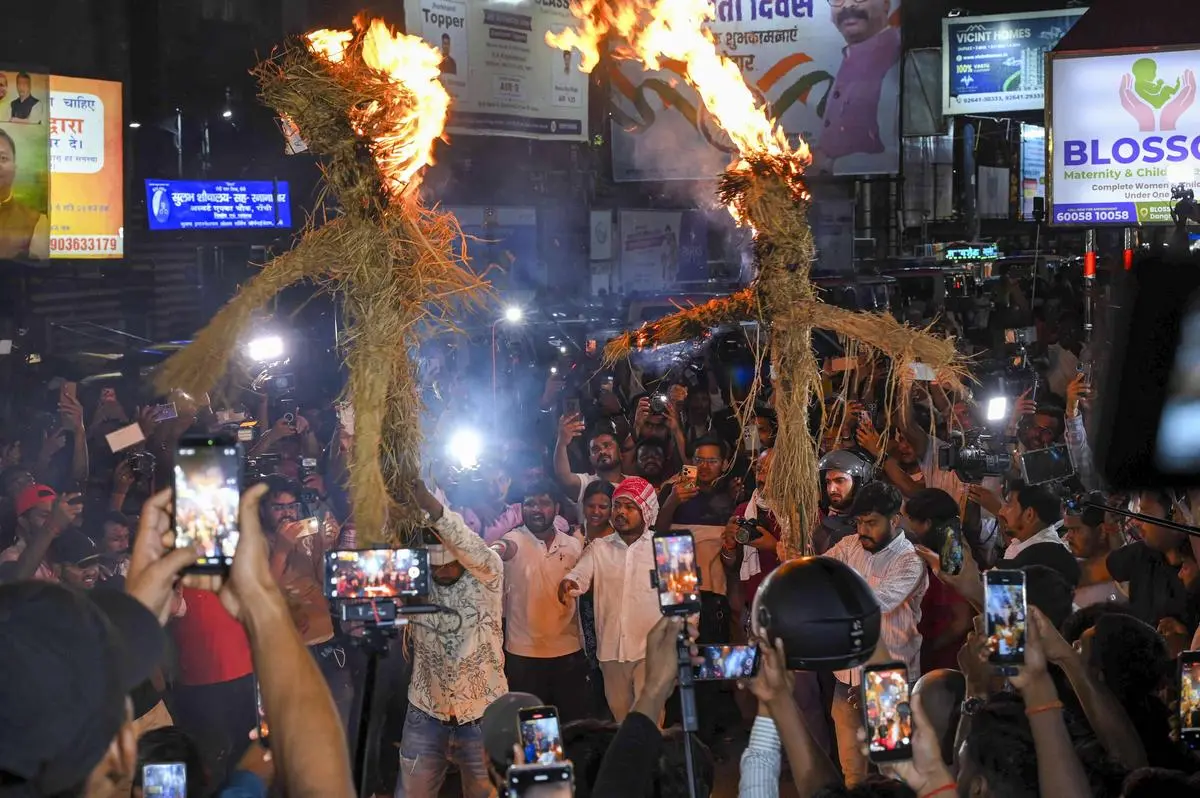
Ranchi: The ongoing Jharkhand students' protest over alleged irregularities in government recruitment examinations intensified on Sunday as demonstrators in Ranchi and other parts of the state burnt effigies of Chief Minister Hemant Soren and Congress leader Rahul Gandhi. Demands for increased transparency in the recruitment tests administered by the Jharkhand Public Service Commission (JPSC) and Jharkhand Staff Selection Commission (JSSC) are at the heart of the protest, which has been going on for more than three weeks. Students have been pressing the state government to order a Central Bureau of Investigation (CBI) inquiry into the allegations. Protesters' discontent with what they perceived as the government's lack of tangible action led to the most recent escalation. The ruling alliance is under pressure to find a solution as the protests have grown in importance as a political issue in Jharkhand.
Students step up pressure on government
Students gathered at Jaipal Singh Munda Stadium in Ranchi, which has become a focal point of the agitation. Protesters raised slogans and criticised the state government over its handling of the examination controversy. Similar demonstrations were reported from other parts of Jharkhand, with protesters targeting the political leadership through effigy burning. The action against Hemant Soren and Rahul Gandhi reflected growing frustration among sections of the protesting students. Allegations regarding tests, such as the JPSC Combined Civil Services Examination and the JSSC Combined Graduate Level examination, are connected to the protests. Protesters have questioned the transparency of recruitment procedures and are demanding an independent investigation. The students contend that if misconduct is eventually proven, a central agency's investigation would aid in establishing the facts and identifying those guilty.
CBI investigation remains the central demand
The demand for a JPSC CBI probe has remained one of the most prominent issues in the students' campaign. Because candidates spend years studying for government employment, aspirants have frequently contended that scandals surrounding competitive tests can have major repercussions. The impartiality of the entire hiring process is thus called into question by any claim of paper leaks, manipulation, or procedural irregularities. Students requested revisions in the recruitment process and probes into a number of contested exams, according to earlier reports from the demonstration. They have also called for stronger safeguards to prevent similar controversies in future examinations. The issue has also attracted political attention. Opposition leaders have criticised the Jharkhand government and supported demands for an independent investigation. BJP leaders have separately called for a CBI inquiry into alleged irregularities in JPSC and JSSC recruitment examinations.
Fresh round of talks offered by Jharkhand government
Amid the renewed confrontation, the state administration has made another attempt to bring the protesters back to the negotiating table. According to reports, the Jharkhand government invited representatives of the protesting students for another round of discussions in Ranchi on Monday, August 17. The meeting is being viewed as another opportunity to find common ground after earlier rounds of talks failed to produce a settlement. The administration's latest move comes at a crucial point in the agitation. Students have indicated that they could intensify their campaign if their major demands are not addressed. Reports have also indicated that protesters have warned of further action, including a proposed march towards the Chief Minister's residence if they do not receive a satisfactory response.
Political pressure grows around JPSC-JSSC controversy
The JPSC JSSC protest 2026 has gradually moved beyond an examination-related dispute and developed into a wider political confrontation. For the protesting students, the issue is primarily about employment, fairness and confidence in the recruitment system. For the government, bringing the agitation to an end without compromising ongoing administrative or legal processes presents a significant challenge. The controversy has also provided opposition parties with an opportunity to question the government's handling of youth and employment-related issues. BJP leaders have repeatedly demanded accountability and a central investigation, while the government has maintained that it is engaging with students and examining their concerns. The situation has become particularly sensitive after earlier demonstrations in Ranchi saw clashes between protesters and police. On August 10, thousands of young people marched towards the state legislature, following which police used tear gas, water cannons and batons to disperse the crowd after the situation escalated.
What happens next?
The latest talks could prove important for determining the direction of the Jharkhand students' protest. Students are seeking a clear response on their demand for a CBI investigation and action concerning the examinations they believe were affected by irregularities. The government, meanwhile, faces the task of addressing those concerns while preventing the agitation from becoming more confrontational. The coming days are therefore likely to be closely watched by students, job aspirants and political parties across Jharkhand. For thousands of candidates preparing for government employment examinations, the dispute is about more than a single examination. It has become a question of whether recruitment processes can provide a transparent and trustworthy path to government jobs. With another round of talks scheduled and protesters threatening further escalation, the JPSC-JSSC controversy remains one of the most closely watched issues in Jharkhand. Whether negotiations can produce a concrete solution or the agitation enters a new phase will depend largely on the government's response to the students' demands.